
AI Agents for Recruiting: What Each One Does and Where Each Falls Short
A breakdown of 7 AI agent types for recruiting: what each handles, where it works, where it fails, and how to implement them responsibly.

By: Deepit Patil
Co-Founder and CTO
Published
Updated
Edited by Craze Editorial Team · See our Editorial Process
Recruiters spend the majority of their week on tasks that do not require their expertise: scanning resumes, coordinating interview schedules, sending status update emails, chasing references. Meanwhile, candidates get ghosted and top talent takes another offer.
AI in recruiting is not new. Most teams already use an ATS that filters resumes or a generative AI tool that drafts job descriptions. AI agents are a different category. These are autonomous systems that own entire recruiting tasks and adapt their approach based on results, without waiting for you to prompt each step. And adoption is accelerating. McKinsey’s 2025 State of AI survey found that 62% of organizations are already experimenting with AI agents, though only 23% have scaled them in even one business function.
This article breaks down what AI recruiting agents actually are, 7 agent types that matter for recruiting teams in 2026, where each delivers, where each fails, and how to choose your first one.
TL;DR
- AI agents go beyond standard AI tools. They own multi-step recruiting tasks autonomously rather than assisting with one action at a time.
- 7 agent types cover the hiring funnel: sourcing, screening, engagement, scheduling, assessment, reference checks, and outreach.
- Every agent type has real limitations. Scheduling agents struggle with nuanced availability, engagement chatbots frustrate candidates with repeated questions, and screening agents can reproduce historical bias at scale.
- US compliance applies. Bias audits, candidate disclosure, and human-in-the-loop are legally required in multiple states.
- Start with one agent matched to your biggest bottleneck. Pilot for 90 days, measure against a baseline, then scale.
What Is an AI Recruiting Agent?
An AI recruiting agent is software that runs multi-step hiring tasks on its own. You give it a goal (“screen these 400 applicants against this job description”), and it works through the steps, makes decisions along the way, and delivers a result without needing you to intervene at each stage.
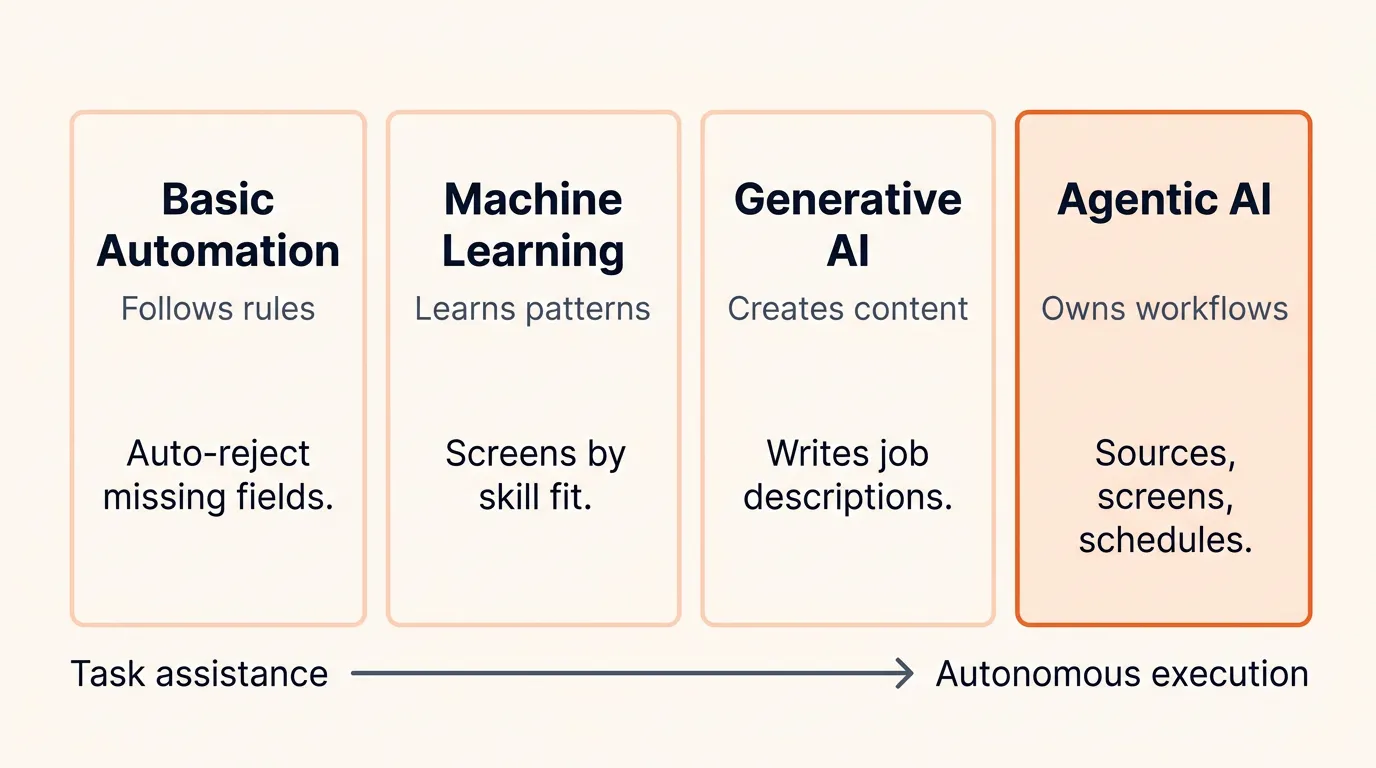
That sounds like what a lot of recruiting tools already claim to do. It is not. Most AI tools in recruiting today fall into one of two categories, and neither one is an agent:
- Basic automation follows rules you set. Candidate applies, confirmation email fires. Resume missing a required field, it gets rejected. No learning, no adaptation. You build the workflow once; it runs the same way every time.
- Generative AI creates content on demand. You prompt it, it writes a job description or an outreach email, and then it stops. You decide what to do next. Useful, but it waits for you at every step.
AI agents work differently. A screening agent does not just scan resumes for keywords. It evaluates hundreds of applications against your role requirements, ranks candidates by fit, and delivers a shortlist. If a highly ranked candidate declines, the agent adjusts its scoring to surface the next best match. It handles the full sequence, not just one step.
Five things that make a recruiting AI an actual agent:
- It completes multi-step tasks without a prompt at each stage. You define the goal. The agent handles the sequence.
- It adapts based on outcomes. When candidates drop off, get rejected, or move forward, the agent adjusts its approach. It does not wait for you to update its settings.
- It connects to your existing systems. It reads from and writes to your ATS, calendar, and communication tools rather than operating in isolation.
- It improves over time. It refines its criteria based on which candidates get hired, which get rejected, and where drop-offs happen.
- It keeps humans in control. Recruiters maintain visibility, can override any decision, and set escalation rules for edge cases.
If the tool you are evaluating does not do all five, it is likely automation or generative AI with an “agent” label. That distinction matters when you are deciding what to trust it with.
7 AI Agent Types for Recruiting Teams
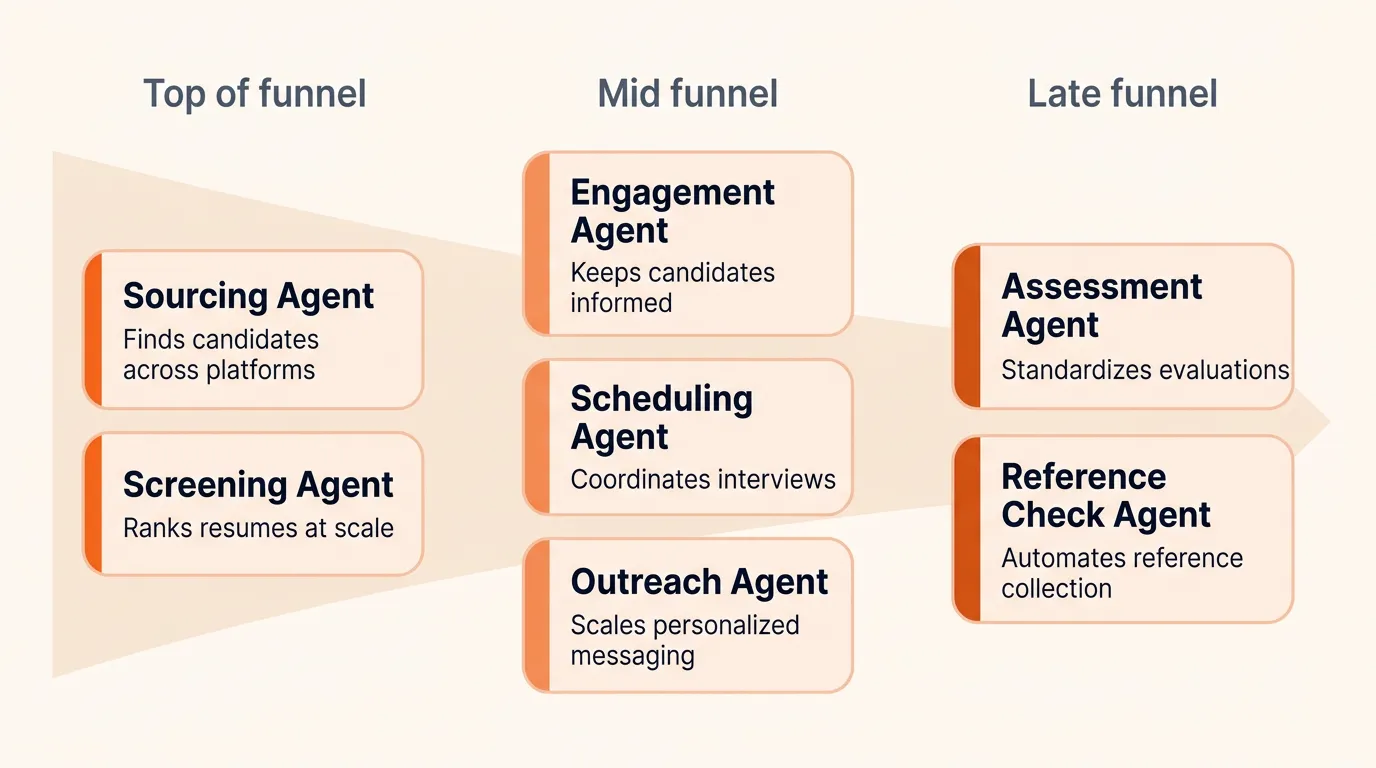
Here are the agent types that matter most for recruiting in 2026, organized by where they sit in your hiring funnel.
1. Sourcing agents
What it does: Scans professional networks, job boards, code repositories, portfolio sites, and your own ATS simultaneously. Identifies passive candidates who match your criteria but are not actively job searching. Rediscovers qualified people already in your database from previous requisitions who were never contacted again.
The real advantage over manual sourcing is continuous refinement. When a sourced candidate gets hired and performs well, the agent updates its model of what a strong match looks like for that role type. Over time, your AI candidate sourcing pipeline gets more targeted without manual recalibration.
Business impact: Nearly half of tech recruiters spend at least 30 hours a week on sourcing alone. AI sourcing agents compress that discovery phase significantly, with early adopters reporting 60 to 70 percent reductions in time-to-screen by running multi-platform searches in parallel instead of sequentially.
Where it struggles: Niche roles with thin online presence (specialized manufacturing, certain government positions) get poor results because the agent has less data to work with. Sourcing agents also cannot assess soft skills, cultural fit, or motivation, so the shortlist still requires human evaluation before outreach begins.
Best for: High-volume roles, passive candidate discovery, ATS rediscovery.
2. Screening agents
What it does: Processes hundreds to thousands of resumes, extracting skills, matching them against role requirements, and producing a ranked shortlist. Goes beyond keyword matching. A screening agent understands that “led a distributed engineering team across three time zones” signals both leadership and remote management experience even when those exact terms are not on the resume.
Modern screening agents use weighted scoring across multiple dimensions. A typical setup might weight technical skills at 40%, experience relevance at 25%, communication indicators at 20%, and cultural signals at 15%, then produce a score with clear explanations for each rating.
Business impact: This is the most reliably positive use case when measuring AI recruiting ROI . SHRM’s 2025 Talent Trends data shows that 89% of HR professionals using AI in recruiting report time savings, and screening is the primary driver. An estimated 88% of companies now use some form of AI for initial applicant screening.
Where it struggles: Screening agents trained on biased historical data reproduce that bias at scale. One Harvard Business School study found that automated screening software collectively filters out roughly 27 million capable job seekers in the US, disproportionately affecting caregivers, veterans, immigrants, and people with work gaps. A University of Washington study (2025) found AI resume tools favored white-associated names in 85.1% of cases. These are not edge cases. They are structural risks that require ongoing bias audits and human oversight.
Best for: High-volume roles with clear qualification criteria. Requires regular bias testing.
3. Engagement agents
What it does: Maintains candidate communication across email, SMS, and chat around the clock. Sends application confirmations and status updates automatically. Answers common questions about the role, timeline, and next steps. Requests additional documents. Keeps candidates warm between interview stages.
Business impact: Between application and offer, candidates are often left waiting with no updates. An estimated 60% of candidates have abandoned applications due to poor communication and delays. Engagement agents address this by ensuring every candidate gets timely responses, even outside business hours.
Where it struggles: Engagement chatbots create frustration when they repeat questions, misunderstand nuance, or fail to escalate to a human. A 2026 research study found that candidates’ expectations are often unmet compared to what AI recruiting systems promise, leading to diminished trust. The core problem is that chatbots cannot evaluate soft skills, read emotional context, or adapt based on individual circumstances the way a human recruiter can. Every handoff from chatbot to human also creates a “context transfer tax,” where the recruiter must read the entire chat history before responding, often taking longer than if the candidate had spoken to a human from the start.
Best for: High-volume status communications and FAQ handling. Keep sensitive conversations, complex queries, and candidates in late-stage processes with a human.
4. Scheduling agents
What it does: Handles calendar syncing across multiple interviewers and time zones, candidate self-booking, automated reminders, and rescheduling. Eliminates the back-and-forth email chains that add days to every hire.
Business impact: Scheduling consumes an estimated 38% of recruiter time, according to GoodTime’s 2026 Hiring Insights Report. Teams using automated scheduling are 1.6 times more likely to achieve their hiring goals. When well-implemented, scheduling agents cut time-to-interview significantly and reduce no-shows through automated reminders.
Where it struggles: Calendar APIs were not designed for agent use, leading to critical failure modes: timezone arithmetic errors, inability to handle multi-party coordination, and collapsing under complexity when more than two people are involved. One practitioner who tracked 47 hires documented that scheduling agents could not handle nuanced availability like “I am free Tuesday but only after 3 PM,” repeatedly suggesting times the candidate explicitly rejected. Three candidates in that deployment stopped responding entirely after scheduling failures.
Best for: Straightforward multi-stage pipelines where availability is clearly structured. For panel interviews, executive schedules, or candidates traveling across time zones, human coordination still produces better results.
5. Assessment and scoring agents
What it does: Administers skills tests, aggregates evaluation data from sourcing, screening, and interview stages, and generates structured candidate profiles with comparative rankings, strengths, risks, and transparent reasoning. Some agents also transcribe and summarize video interviews.
Assessment platforms typically score candidates across six pillars: candidate experience (20%), signal quality (25%), engagement and scheduling (15%), integrations (15%), reporting and auditability (15%), and security and governance (10%).
Business impact: Replaces the manual process of a recruiter synthesizing notes from multiple touchpoints. Provides standardized comparison data so hiring teams work from consistent information rather than subjective impressions.
Where it struggles: Video and voice analysis features face the most regulatory scrutiny. The EU AI Act classifies recruiting AI as “high-risk.” California and Colorado mandate disclosure when AI analyzes facial expressions or tone of voice. Predictive models that forecast retention or performance also raise fairness questions, because the signals they use (university attended, zip code, employment gaps) can serve as proxies for protected characteristics.
Best for: Technical roles and skills-based hiring where structured evaluation improves consistency. Be cautious with video/voice analysis until your compliance posture is clear.
6. Reference check agents
What it does: Sends structured questionnaires to candidate references via email or SMS, follows up automatically with reminders, analyzes feedback for patterns and red flags, and generates summary reports with sentiment analysis.
Business impact: Traditional phone-based reference checks take 3 to 5 days of back-and-forth. Dedicated automated reference check platforms like Xref report 18-hour average turnaround times with structured questionnaires. The consistency advantage is real: every reference answers the same questions, making comparison across candidates more reliable than ad-hoc phone calls.
Where it struggles: The results depend heavily on the tool. Specialized reference platforms with built-in reminder sequences and structured questionnaires perform well. But when a generic AI agent sends reference request emails without those sequences, the response rates drop sharply. One practitioner tracked a 60% ignore rate for basic automated reference emails, compared to 85% response rates when a human followed up. The takeaway: use a purpose-built reference check tool, not a general-purpose AI agent trying to handle references as a side task.
Best for: Standardized reference collection at scale using a dedicated platform. Keep human follow-up for senior hires and roles where the reference relationship carries significant weight.
7. Outreach agents
What it does: Drafts personalized candidate messages based on profile data, manages multi-step follow-up sequences across email, LinkedIn, and SMS, and tracks engagement metrics. Tests different messaging approaches and adjusts timing and content based on response patterns.
Business impact: Follow-up matters more than most recruiters realize. An estimated 42% of all candidate replies come from follow-up messages, not the initial email. Multi-step sequences of 6 to 7 emails produce response rates up to 450% higher than single-email outreach. Outreach agents automate this sequencing so recruiters do not have to manage follow-up cadences manually.
Where it struggles: Generic, high-volume messaging trains candidates to ignore you and damages your employer brand over time. True personalization requires connecting the opportunity to a candidate’s specific experience and likely motivations, not just inserting their name into a template. AI-drafted messages still need human review before sending for senior or executive outreach, where a formulaic tone is immediately obvious.
Best for: Initial outreach at scale, follow-up sequencing for active pipelines, multi-channel campaigns for mid-level roles.
What to Watch Out For
Agents can create new problems while solving old ones
Agents that save time at one stage can create hidden costs elsewhere. One practitioner who tracked this carefully found that screening agents saved significant time, but the scheduling agent downstream created enough conflicts that net savings were roughly a third of what the screening agent alone would suggest. Measure the full recruitment process automation impact, not just individual agent performance.
”Agent washing” is widespread
Not every tool marketed as an “AI agent” actually operates autonomously. Many vendors have relabeled basic automation or generative AI features as “agentic.” True AI agents execute multi-step workflows end-to-end and adapt based on outcomes. If the tool still requires you to prompt, review, and advance each step manually, it is not an agent regardless of the marketing. Ask vendors to demonstrate autonomous workflow execution, not just individual task performance.
Some decisions should stay with humans
- Compensation negotiation and closing. High-stakes, emotionally complex conversations where human judgment and flexibility are non-negotiable.
- Executive and senior-level assessment. Relationship-driven, low-volume hiring does not benefit from agent autonomy.
- Sensitive rejections. Candidates who invested significant time in your process deserve thoughtful, personal communication.
- Final hiring decisions. An estimated 70% of companies currently let AI reject candidates autonomously without human oversight. That creates both legal vulnerability and quality-of-hire risk.
A Note on Compliance
AI agents in recruiting are subject to the same anti-discrimination laws as any other employment practice. The EEOC treats them identically under Title VII, the ADA, and the ADEA. Multiple states, including New York City, California, Illinois, Texas, and Colorado, now require bias audits, candidate disclosure, and human oversight for automated hiring tools, with penalties for non-compliance.
The three non-negotiables before deploying any AI agent: run regular bias audits across protected categories, disclose AI involvement to candidates, and keep a human approving final hiring decisions. Our guide to AI in recruitment covers the full US compliance landscape for 2026, including specific state regulations and recent case law.
How to Choose Your First AI Agent
Not every team needs all seven agent types. Start with one matched to your biggest bottleneck.
Drowning in applications? Start with a screening agent. This consistently delivers the fastest ROI by cutting initial review time from days to minutes.
Candidates dropping off mid-process? Start with an engagement agent. Automated status updates and FAQ handling reduce the silence that drives candidates away.
Scheduling eating your week? Start with a scheduling agent, but go in knowing the limitations around nuanced availability. It works best for straightforward multi-stage pipelines.
Pipeline too narrow? Start with a sourcing agent. Multi-platform scanning and ATS rediscovery broaden your pool without adding recruiter hours.

Conclusion
When used well, AI agents give recruiting teams something they rarely have: time. Sourcing agents surface candidates you would never find manually. Screening agents cut days of resume review to minutes. Engagement agents keep candidates warm while your team focuses on high-value conversations. Scheduling agents remove the back-and-forth that slows every hire. The operational impact is real, but only when you match the right agent to the right bottleneck, run a focused pilot, and keep human oversight where it matters.
The bigger question is not which agent to start with. It is whether your current tooling lets you deploy these agents without integration overhead eating the time savings. Pick one bottleneck, run a 90-day pilot against a clear baseline, and build from there.
FAQs
What is an AI recruiting agent?
An AI recruiting agent is autonomous software that manages multi-step hiring tasks without requiring human input at every stage. Unlike chatbots that follow scripted flows or generative AI that creates content from prompts, an AI agent pursues a hiring goal by chaining tasks together (sourcing, screening, scheduling) and adapting its approach based on results.
What are the main types of AI agents used in recruiting?
The primary types are sourcing agents (find candidates across platforms), screening agents (evaluate resumes at scale), engagement agents (maintain candidate communication), scheduling agents (coordinate interviews), assessment agents (administer tests and aggregate evaluations), reference check agents (automate reference collection), and outreach agents (scale personalized messaging).
What are the risks of using AI agents in recruiting?
The main risks are bias perpetuation from historical training data, over-automation of judgment-dependent decisions, compliance exposure under expanding US regulations, scheduling failures and candidate frustration from poor edge-case handling, and agent washing where vendors market basic automation as agentic AI.
Which AI is used for recruitment?
Recruiting teams use several AI categories: machine learning for screening and candidate matching, natural language processing for chatbots and semantic search, generative AI for content creation like job descriptions and outreach messages, and agentic AI for autonomous multi-step workflow execution across the hiring funnel.
More Articles
15+ AI Agent Examples That Are Actually Delivering Results

See real AI agent examples from companies like Uber, TELUS, and Intercom. Organized by function with actual business results, not just product names.
AI Agent Builders: How to Pick the Right Approach for Your Team
Compare no-code AI agent builders, developer frameworks, and custom approaches. Includes a decision matrix, cost ranges, and production readiness checklist.
How to Build an AI Agent (Even If You Can't Code)
Learn how to build an AI agent using no-code tools, frameworks like LangChain, or custom Python. Covers scoping, costs, and mistakes to avoid.


