
Recruitment Process Automation: How to Automate Hiring Without Losing the Human Touch
Learn which recruiting tasks to automate first, how to implement automation step by step, common mistakes to avoid, and how to measure ROI across your hiring funnel.

By: Deepit Patil
Co-Founder and CTO
Published
Updated
Edited by Craze Editorial Team · See our Editorial Process
Recruiters spend nearly half their working hours on administrative tasks: scheduling interviews, posting jobs to a dozen boards, chasing hiring managers for feedback, sending status update emails, and re-screening resumes that should have been filtered before they ever reached the inbox. Meanwhile, the candidates who deserve attention are waiting for responses that never come fast enough.
Recruitment process automation is supposed to fix this, and it can when applied to the right tasks. But SHRM’s 2025 benchmarking data tells a more complicated story. Both cost-per-hire and time-to-hire have increased over the past three years, even as AI adoption in recruiting has surged. The problem is not the technology itself. It is how teams implement it.
This guide covers which parts of recruiting are worth automating, how to implement automation without losing the human touch, which mistakes derail the process, and how to measure whether any of it is actually working.
TL;DR
- Recruitment process automation uses AI and workflow tools to handle repetitive hiring tasks like resume screening, job posting, interview scheduling, and candidate communication.
- Start with high-volume, rules-based tasks first. Keep human judgment for direct conversations, negotiations, and sensitive rejections.
- Implementation matters more than tool selection. Map your workflow, pilot on a single role, train your team, and measure before scaling.
- Track time-to-hire, cost-per-hire, candidate experience, and quality of hire. Automation without measurement is faster guessing.
- When internal capacity is limited, outsourcing specific recruitment functions can complement automation rather than replace it.
What Is Recruitment Process Automation?
Recruitment process automation is the use of software, AI, and workflow tools to complete repetitive, rules-based recruiting tasks that would otherwise consume recruiter time. It covers everything from automatically distributing job postings across multiple boards to using natural language processing to screen and rank hundreds of resumes in minutes.
There is an important distinction between simple automation and AI-powered automation:
- Simple automation follows fixed rules. An email sequence that sends a confirmation when a candidate applies, or a workflow that routes a job requisition through approval chains, is automation without AI.
- AI-powered automation learns and adapts. Resume screening that recognizes “managed a team of 12” as leadership experience, even when “management” is not listed as a skill, goes beyond fixed rules. So do predictive tools that rank candidates by likely success based on historical hiring patterns. Our walkthrough on how to use AI in recruitment includes prompts and examples at each stage.
Both have a place. The recruitment stages where automation commonly applies include sourcing, screening, scheduling, candidate communication, evaluation, offer management, and onboarding.
Adoption is moving fast. An estimated 69% of HR professionals now use AI in recruiting, up from roughly half the year before, with projections reaching 81% by 2027. The question for most teams is no longer whether to automate, but which tasks to automate first and how to avoid the mistakes that cancel out the gains.
Which Parts of Recruiting Should You Automate First?
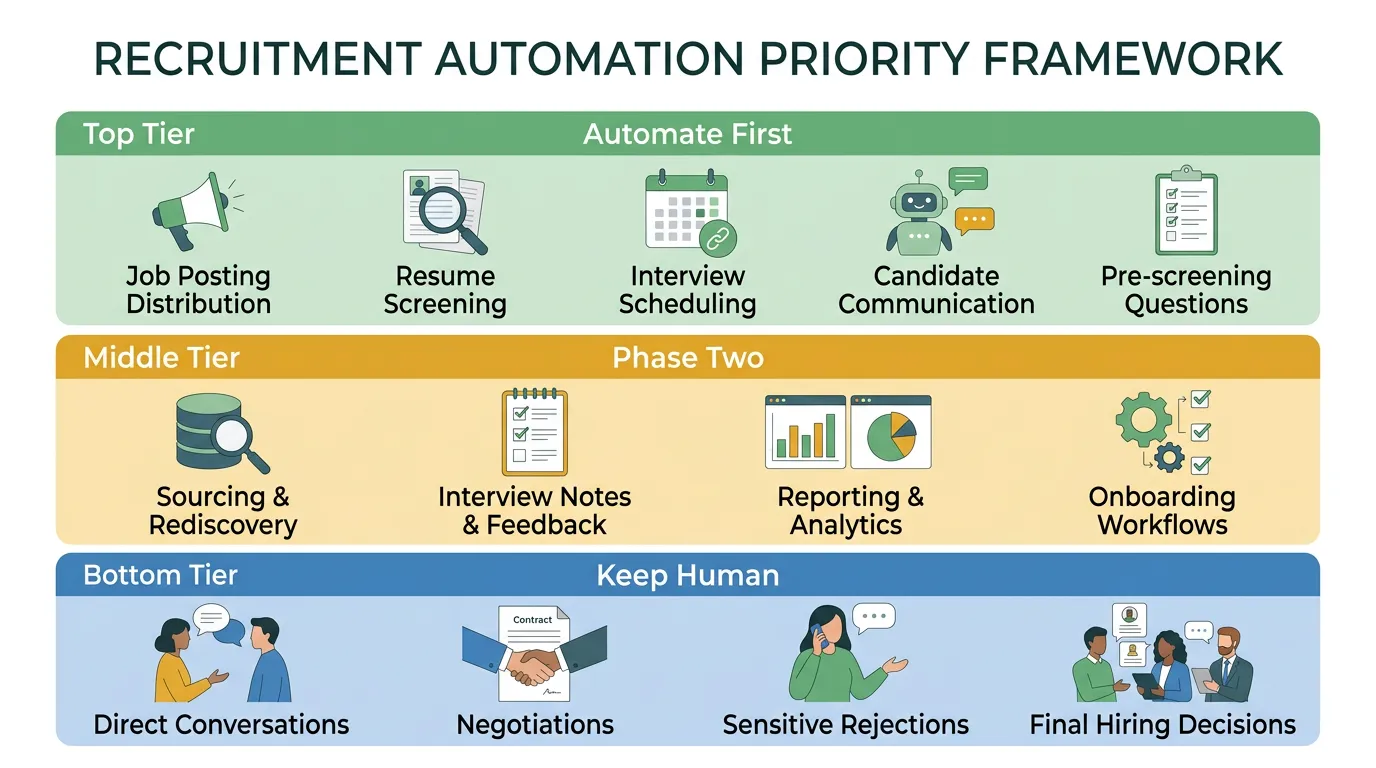
Not every recruiting task benefits equally from automation. The highest returns come from tasks that are high volume, repetitive, rules-based, and prone to delays. The worst outcomes come from automating moments that require empathy, judgment, or relationship building.
High-Value Automation Targets (Start Here)
Job posting and distribution. Manually uploading the same job to dozens of boards wastes hours every week. Automation distributes openings across platforms simultaneously, including LinkedIn, Indeed, Glassdoor, and niche industry boards, so recruiters can spend that time on sourcing or candidate conversations instead.
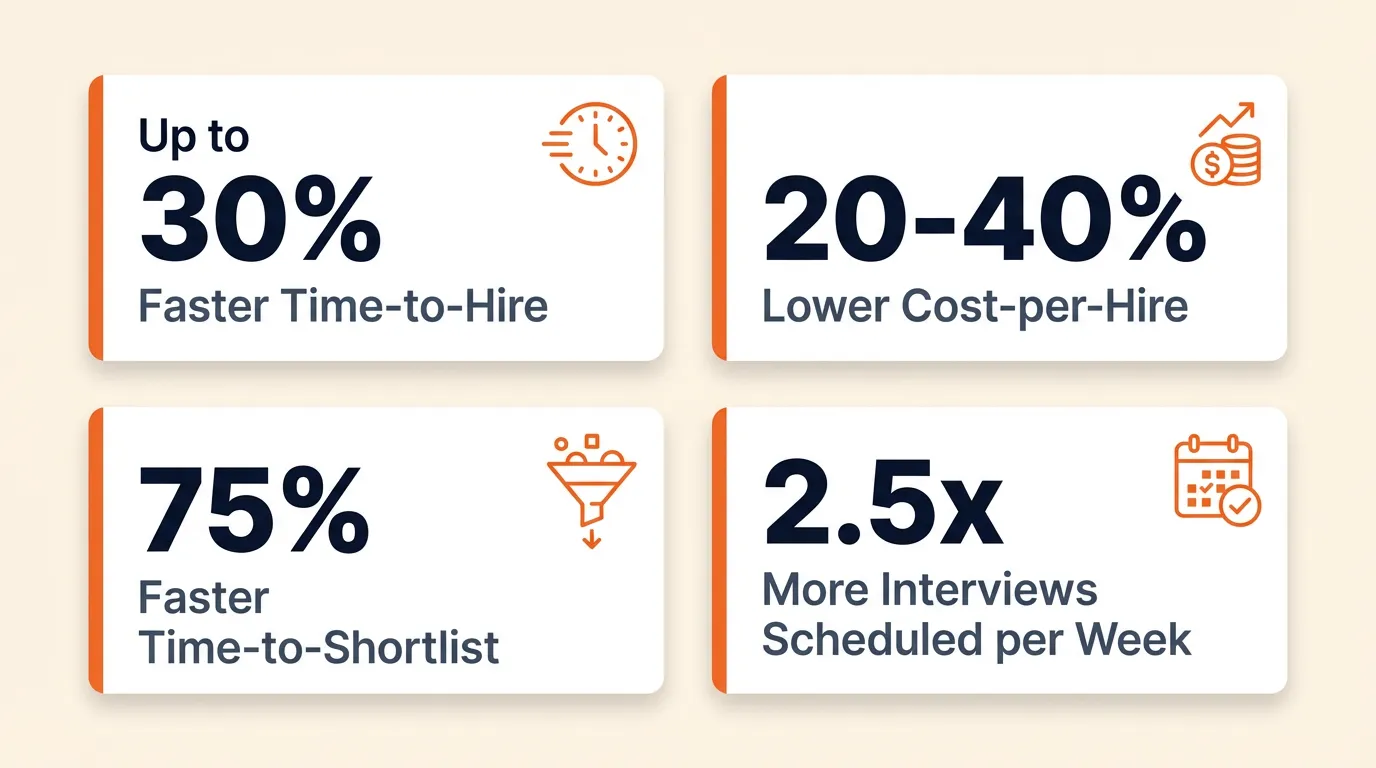
Resume screening and shortlisting. This is where automation delivers the most visible efficiency gain. AI-powered parsing tools evaluate applications against job requirements, extract skills, and produce ranked shortlists. The time savings are significant: AI screening cuts time-to-shortlist by up to 75%, saving an average of 23 hours per hire.
Interview scheduling. Calendar syncing, candidate self-booking, and automated reminders eliminate the back-and-forth that costs days per hire. Recruiters using scheduling automation can handle 2.5x more interviews per week.
Candidate communication sequences. Automated acknowledgments, status updates, reminders, and follow-ups keep candidates informed throughout the process. No more “black hole” applications where candidates submit their resume and hear nothing for weeks.
Pre-screening questions. Killer questions and scored questionnaires filter applicants automatically before a recruiter reviews any resumes. This removes clearly unqualified candidates early and lets recruiters focus on the shortlist.
Phase-Two Automation
Sourcing and candidate rediscovery. AI tools scan databases, LinkedIn, and your ATS to surface qualified candidates and reconnect with previous applicants who match current roles. Most ATS databases are full of overlooked candidates from earlier requisitions, and the best AI recruiting tools now automate much of this rediscovery work.
Interview note capture and feedback collection. AI-generated interview summaries and automated feedback reminders ensure interviewers submit structured evaluations while the conversation is still fresh. This prevents the delays that stall hiring decisions.
Reporting and analytics. Automated dashboards replace weekly spreadsheet gymnastics with real-time visibility into pipeline health, conversion rates, source effectiveness, and bottleneck identification.
Onboarding workflows. When a candidate accepts an offer, automation triggers background checks, generates onboarding paperwork, and initiates IT provisioning without manual hand-offs between HR, IT, and the hiring manager.
Keep Human (Do Not Automate)
Some recruiting tasks lose their value entirely when automated:
- Direct candidate conversations and relationship building. Personalized outreach to high-value candidates requires context, empathy, and authenticity. Generic automated messages damage your employer brand.
- Compensation negotiations and offer discussions. These conversations are high stakes and emotional, requiring flexibility and human judgment.
- Sensitive rejections. Candidates who invested significant time in your process deserve thoughtful, personal communication, especially when delivering difficult news.
- Final hiring decisions. AI can rank and score, but the accountability for the decision should rest with a person who can explain and defend it.
- Complex accommodations or exceptions. Non-standard situations require discretion that rules-based systems cannot provide.
How to Implement Recruitment Process Automation Step by Step
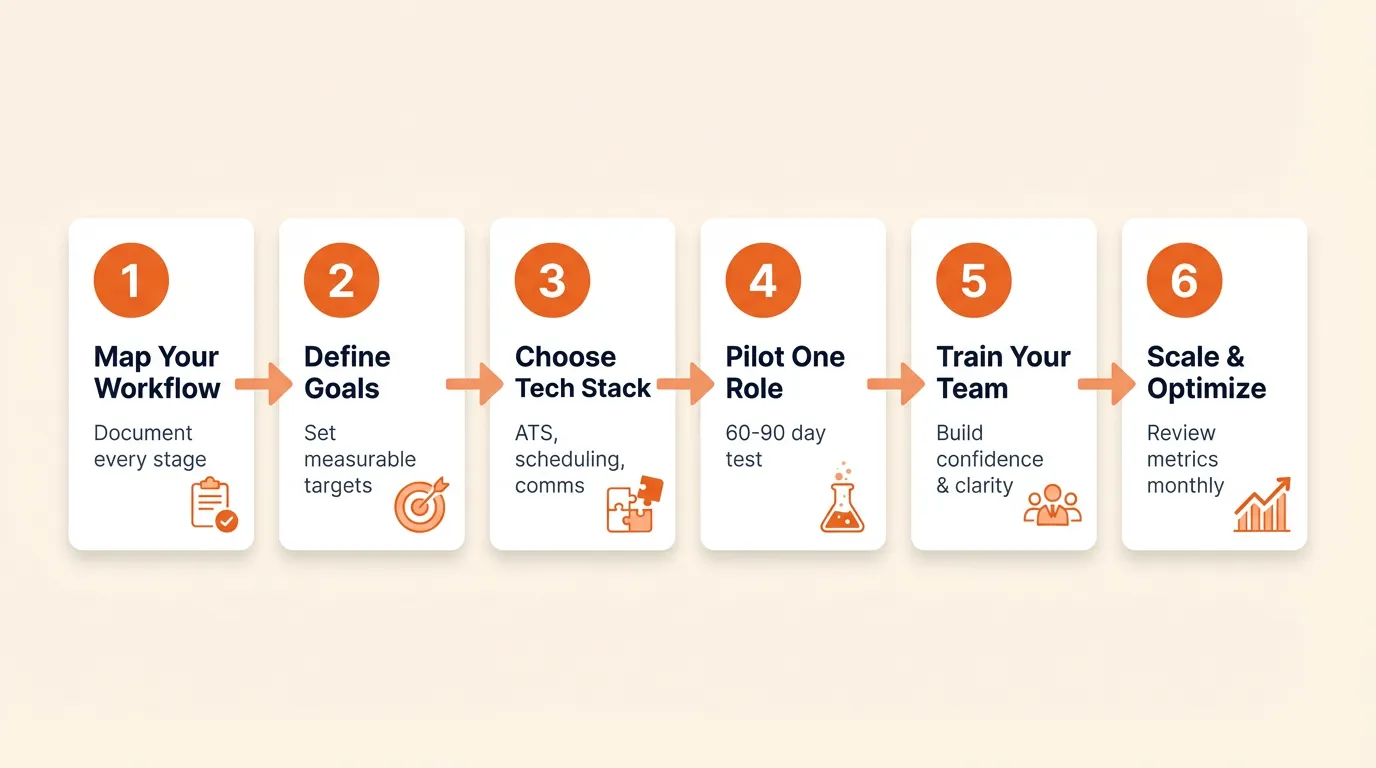
Knowing what to automate is different from knowing how to roll it out. The implementation sequence matters more than the tool you choose.
Step 1: Map Your Current Recruitment Workflow
Document every stage from job requisition to onboarding. Identify who is involved at each step, which systems are used, and where manual work accumulates. Flag the tasks that are highest volume, most repetitive, and most prone to delays or errors.
This mapping exercise often reveals bottlenecks that are not obvious from inside the daily workflow. A recruiter might not realize that scheduling alone consumes 8 hours per week until it is documented.
Step 2: Define Measurable Goals
Set specific targets before selecting any tools. Examples:
- Reduce time-to-hire by 25%
- Cut resume screening time by 50%
- Improve candidate response rates by 15%
- Increase recruiter capacity from 15 to 25 open requisitions
Baseline your current metrics first. Without a baseline, you cannot evaluate whether automation is producing results or just shifting the bottleneck.
Step 3: Choose the Right Technology Stack
The core components of a recruitment automation stack include:
- ATS with built-in automation: handles candidate tracking, workflow triggers, and pipeline management
- Scheduling integration: calendar syncing and candidate self-booking
- Communication automation: email sequences, chatbots, and status notifications
- Reporting and analytics: pipeline dashboards, source tracking, and conversion metrics
Evaluate based on integration with your existing HRIS and payroll systems, ease of adoption, and scalability as hiring volume grows. Some teams prefer best-of-breed point solutions stitched together; others consolidate onto a single AI-native platform that handles sourcing, screening, scheduling, and analytics in one place. The right choice depends on your team’s technical comfort and the complexity of your hiring workflow.
Step 4: Pilot on a Single Role or Team
Do not roll automation out across your entire hiring operation at once. Start with one role type, ideally a high-volume position where administrative overhead is highest.
Run the automated workflow for 60 to 90 days. Measure the same metrics you baselined in Step 2 at 30-day intervals. Collect qualitative feedback from recruiters and candidates. Note any quality concerns, unexpected bottlenecks, or candidate experience issues.
Step 5: Train Your Team
Technology adoption fails when recruiters and hiring managers are not trained on the new workflows. Training should cover:
- What the automation does and does not do
- Where human judgment is still required
- How to override automated decisions when needed
- How to interpret AI-generated recommendations and rankings
Address the “replacement” concern directly. Automation handles admin; recruiters handle people. The goal is to give recruiters more time for the work that requires human skill, not to reduce headcount.
Step 6: Scale and Optimize Continuously
Expand automation to additional roles and teams based on pilot results. Review metrics monthly. Adjust screening criteria, communication sequences, and workflow triggers based on data.
Automation is not a one-time project. Hiring needs shift, candidate behavior changes, and new tools become available. The teams that get the most value treat their automation stack as a living system, not a finished installation.
How Automation Actually Improves the Recruitment Process
The benefits of recruitment process automation go beyond “saves time.” When implemented well, the compound effects are measurable across cost, quality, candidate experience, and decision-making.
Faster Time-to-Hire Without Cutting Corners
Companies using automation for sourcing, screening, and scheduling report up to 30% faster time-to-hire on average, according to LinkedIn’s Future of Recruiting research. Some teams report 40-60% reductions when combining AI screening with scheduling automation.
Speed matters. Top candidates often move fast, sometimes accepting another offer within days. Every day of unnecessary delay in your process is a day a competitor can close the candidate first.
Lower Cost-per-Hire at Scale
SHRM’s 2025 benchmarking puts the average cost-per-hire for nonexecutive roles at $5,475. Automation targets the administrative labor component directly: fewer recruiter hours per requisition, faster fills that reduce vacancy costs, and lower reliance on external agencies.
Organizations using AI-powered recruiting tools report 20-40% cost-per-hire reductions, though results vary based on implementation quality and hiring volume.
More Consistent Candidate Experience
Automation ensures every candidate receives timely acknowledgments, status updates, and follow-ups regardless of how busy the recruiter’s week is. This consistency matters: candidate drop-off is highest when applicants wait too long for updates or encounter friction during the process.
Consistent screening processes also reduce unconscious bias by applying the same criteria to every applicant, in the same order, with the same weighting. That does not eliminate bias entirely, but it removes one of the most common entry points for it.
Better Data for Better Decisions
Automated tracking captures funnel conversion rates, source effectiveness, interviewer performance, and candidate drop-off points continuously. Instead of pulling reports manually once a quarter, teams have real-time visibility into what is working and what is not.
This data enables proactive adjustments. If a particular source is generating high application volume but low conversion to interviews, you can reallocate budget before the quarter ends, not after.
Common Mistakes That Derail Recruitment Automation
Automation creates value when applied thoughtfully and new problems when applied carelessly. These are the most common missteps.
Over-Automating Candidate Communication
The most frequent mistake is automating every touchpoint. Candidates can immediately tell when messages lack personalization, and generic automated outreach damages your employer brand, especially with passive candidates and senior hires.
Use automation for logistics: confirmations, reminders, scheduling, and status updates. Personalize when engaging directly with candidates, particularly during outreach, final-round communication, and offer discussions.
Skipping Governance and Compliance
49% of organizations already have formal AI governance policies, with another 38% piloting them, according to the 2025 Recruiter Nation Report. If you are not in either group, you are behind.
Establish rules around data use, bias monitoring, EEOC compliance, and candidate transparency before rolling out automation, not after a problem surfaces. 59% of HR decision-makers rank data privacy and security as the top factor when evaluating AI recruitment software.
Ignoring the AI Arms Race Problem
SHRM research highlights a counterintuitive dynamic: as employers automate screening, job seekers automate applying. AI-generated resumes flood into AI-powered screening systems, creating a cycle that increases volume without improving quality.
Counter this by adding intentional friction where it matters. Skills assessments, structured application questions, and work-sample tasks filter for genuine interest and capability. Automation should reduce friction on the logistics side while maintaining rigor on the evaluation side.
Automating Before Measuring
If you do not have baseline metrics for time-to-hire, cost-per-hire, and candidate experience before implementing automation, you cannot evaluate whether it is working. Too many teams adopt tools based on vendor promises, then have no way to verify the results. Setting a credible baseline and running a controlled pilot, as outlined in our guide to AI recruitment ROI, is the only way to separate real gains from noise.
Measure first. Automate second. Compare continuously.
Underinvesting in Team Training
A powerful automation stack that recruiters do not understand or trust will be underused or misused. Training is not a one-time onboarding session. It includes ongoing calibration, feedback loops, and clear documentation of what the automation does and where human judgment overrides it.
Recruitment Process Automation and Outsourcing: When to Combine Both
Most guides on recruitment process automation ignore the outsourcing question entirely, but it is a decision many hiring teams face. Automation and outsourcing are not opposing strategies. They address different capacity constraints and often work best together.
When Outsourcing Complements Automation
- Seasonal hiring surges. When hiring volume spikes for a quarter or a season, outsourcing to a staffing partner or RPO firm fills the capacity gap faster than building and training an internal team.
- Geographic expansion. Entering a new market where you have no sourcing network or local compliance knowledge is a strong use case for outsourcing. Automation cannot substitute for on-the-ground expertise.
- Niche or executive roles. Specialized searches that require deep industry networks, such as C-suite placements or rare technical skills, benefit from outsourced recruiters with established relationships.
- Compliance-heavy industries. In sectors like healthcare or financial services, outsourced partners with domain-specific compliance expertise reduce risk.
When Automation Reduces the Need for Outsourcing
- High-volume standardized roles. If you hire for the same role types repeatedly, a well-tuned automation stack can handle sourcing, screening, and scheduling internally, reducing agency dependency.
- Strong ATS adoption. Teams that have invested in their ATS and built effective workflows often find that automation handles the volume that previously required outsourced support.
- Mature internal processes. When your internal workflow is already mapped, measured, and optimized, adding automation is more cost-effective than paying an external partner to manage a process you already own.
A Decision Framework
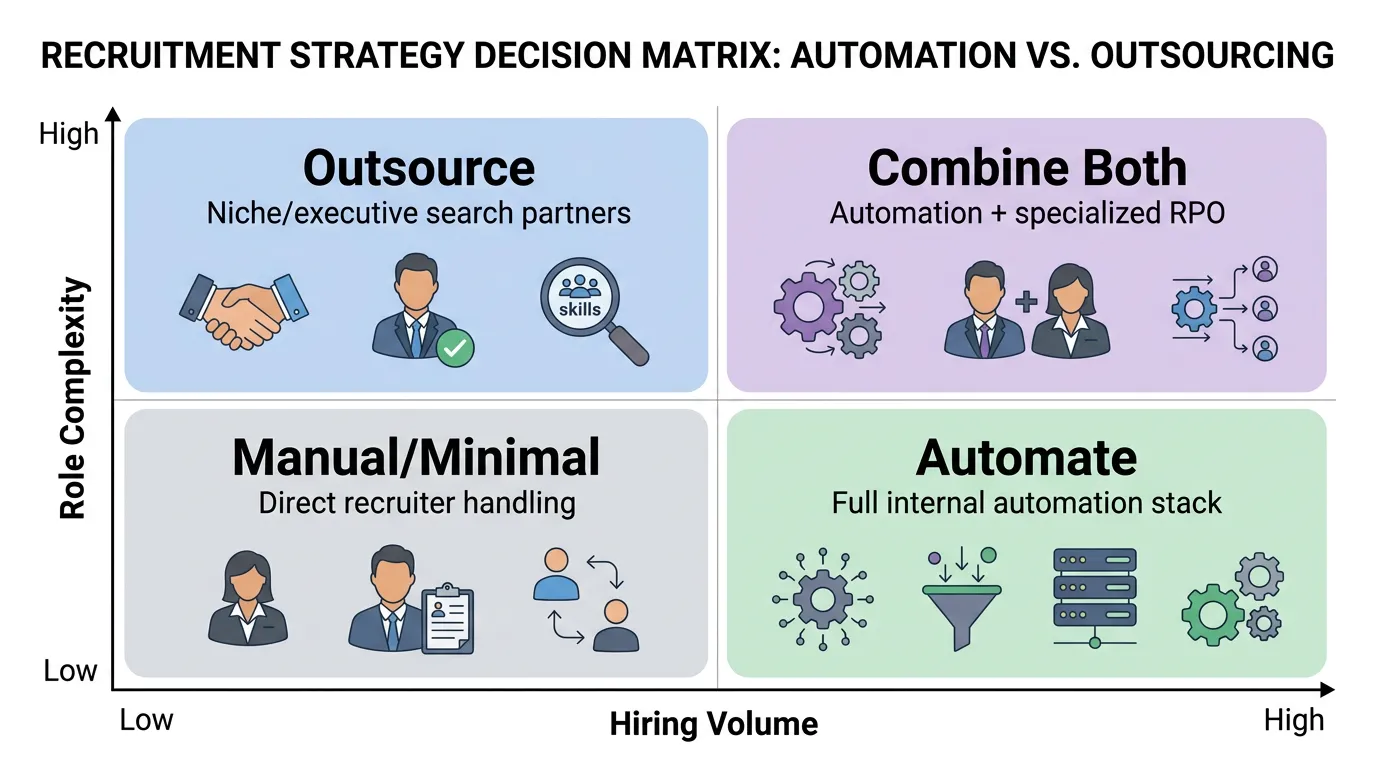
Evaluate each recruitment need across four dimensions:
- Volume: Is the hiring volume consistent or spiky? Consistent volume favors internal automation; spiky volume favors outsourcing as a flex layer.
- Complexity: Are the roles standardized or specialized? Standardized roles are strong automation candidates; specialized roles benefit from outsourced expertise.
- Internal capacity: Does your team have the bandwidth and skills to manage the tools? If not, outsourcing the operational layer while building internal capability is a valid approach.
- Timeline: Is the need immediate or planned? Outsourcing deploys faster; automation takes time to implement but costs less over the long run.
The best RPO partners use automation themselves. The question is not automation versus outsourcing. It is who owns the technology stack and which combination produces the best outcomes for your specific situation.
Start Small, Measure Early, Scale What Works
Recruitment process automation works when it removes administrative friction and keeps humans at the center of the moments that matter. It fails when teams automate indiscriminately, skip measurement, or treat tool selection as a substitute for process design.
The implementation sequence is straightforward: map your workflow, baseline your metrics, pilot on one role, train your team, measure the results, and scale what works. That sequence matters more than which vendor you choose.
As AI capabilities continue to evolve, the recruiters and hiring teams that get the most value will be the ones who treat automation as a force multiplier. Use it to handle the volume, speed up the mechanics, and surface better data. Then invest the time it frees up in the work that actually closes hires: building relationships, advising hiring managers, and creating a candidate experience worth remembering.
FAQs
What is recruitment automation?
Recruitment automation is the use of software and AI to handle repetitive, rules-based tasks in the hiring process, including posting jobs, screening resumes, scheduling interviews, and sending candidate status updates. It supports recruiters by removing administrative drag, not by replacing human judgment in relationship-driven moments like interviews, negotiations, and final hiring decisions.
What are the key stages of the recruitment process you can automate?
The main stages are job posting and distribution, candidate sourcing, resume screening and shortlisting, interview scheduling, candidate communication, evaluation and feedback collection, offer management, and onboarding workflows. Not every stage needs full automation. Prioritize based on volume and repetitiveness, and keep human judgment for conversations, negotiations, and sensitive decisions.
How does automation improve the recruitment process?
Automation reduces time-to-hire by up to 30%, lowers cost-per-hire by 20-40%, and creates a more consistent candidate experience through timely communication at every stage. It also reduces unconscious bias in screening by applying the same criteria to every applicant and gives teams better data for continuous improvement through automated pipeline analytics.
What are the risks of automating recruitment?
The main risks are over-automating candidate communication so it feels impersonal, AI bias if screening models are not regularly audited, compliance gaps when governance policies are missing, and the 'AI arms race' where mass-applying candidates overwhelm mass-screening systems. These risks are manageable with clear governance policies, regular bias testing, team training, and intentional friction at the right stages.
What is the difference between recruitment automation and recruitment outsourcing?
Automation is technology-driven efficiency applied to your internal hiring process. Outsourcing transfers part or all of the recruitment function to an external provider like an RPO firm or staffing agency. They can complement each other: automation handles the administrative layer while an outsourcing partner handles sourcing for niche roles or seasonal surges. The right mix depends on hiring volume, role complexity, and internal team capacity.
More Articles
15+ AI Agent Examples That Are Actually Delivering Results

See real AI agent examples from companies like Uber, TELUS, and Intercom. Organized by function with actual business results, not just product names.
AI Agent Builders: How to Pick the Right Approach for Your Team
Compare no-code AI agent builders, developer frameworks, and custom approaches. Includes a decision matrix, cost ranges, and production readiness checklist.
How to Build an AI Agent (Even If You Can't Code)
Learn how to build an AI agent using no-code tools, frameworks like LangChain, or custom Python. Covers scoping, costs, and mistakes to avoid.


