
AI Candidate Sourcing: How to Source Candidates Using AI
Learn how AI candidate sourcing works, what actually delivers results in 2026, and how to build an AI sourcing workflow that finds better candidates faster.

By: Deepit Patil
Co-Founder and CTO
Published
Updated
Edited by Craze Editorial Team · See our Editorial Process
You have 12 open roles, a hiring manager asking for updates on three of them, and a candidate pipeline that has not moved in two weeks. The default response is to spend another afternoon building boolean strings on LinkedIn, scrolling through the same profiles you saw last month, and hoping someone new shows up.
That is the sourcing reality for most recruiters right now. And it is exactly why AI candidate sourcing has shifted from interesting experiment to operational priority. According to SHRM’s 2025 data, 69% of HR professionals now use AI in some part of their recruiting workflow. But a Workable survey found that only 8% apply it specifically to sourcing, the phase where most recruiter hours actually burn.
This guide covers how AI candidate sourcing works, what real recruiters say about it, where it delivers genuine value, and how to build a practical workflow without falling for the hype.
TL;DR
- AI candidate sourcing automates the identification, screening, and initial engagement of candidates across multiple platforms, letting recruiters focus on relationship-building and evaluation.
- Teams using AI sourcing report 30 to 50% faster time-to-hire and up to 40% lower sourcing costs, though results depend heavily on implementation quality.
- Recruiter feedback is mixed: AI works best for high-volume discovery and outreach drafting, but most tools are not yet mature enough to replace established sourcing workflows entirely.
- US compliance requirements are expanding. NYC, Illinois, and several other states now have or are developing AI hiring regulations that require bias audits and transparency.
- Start with one sourcing bottleneck, run a 90-day pilot against a clear baseline, and keep human judgment at the center.
What Is AI Candidate Sourcing?
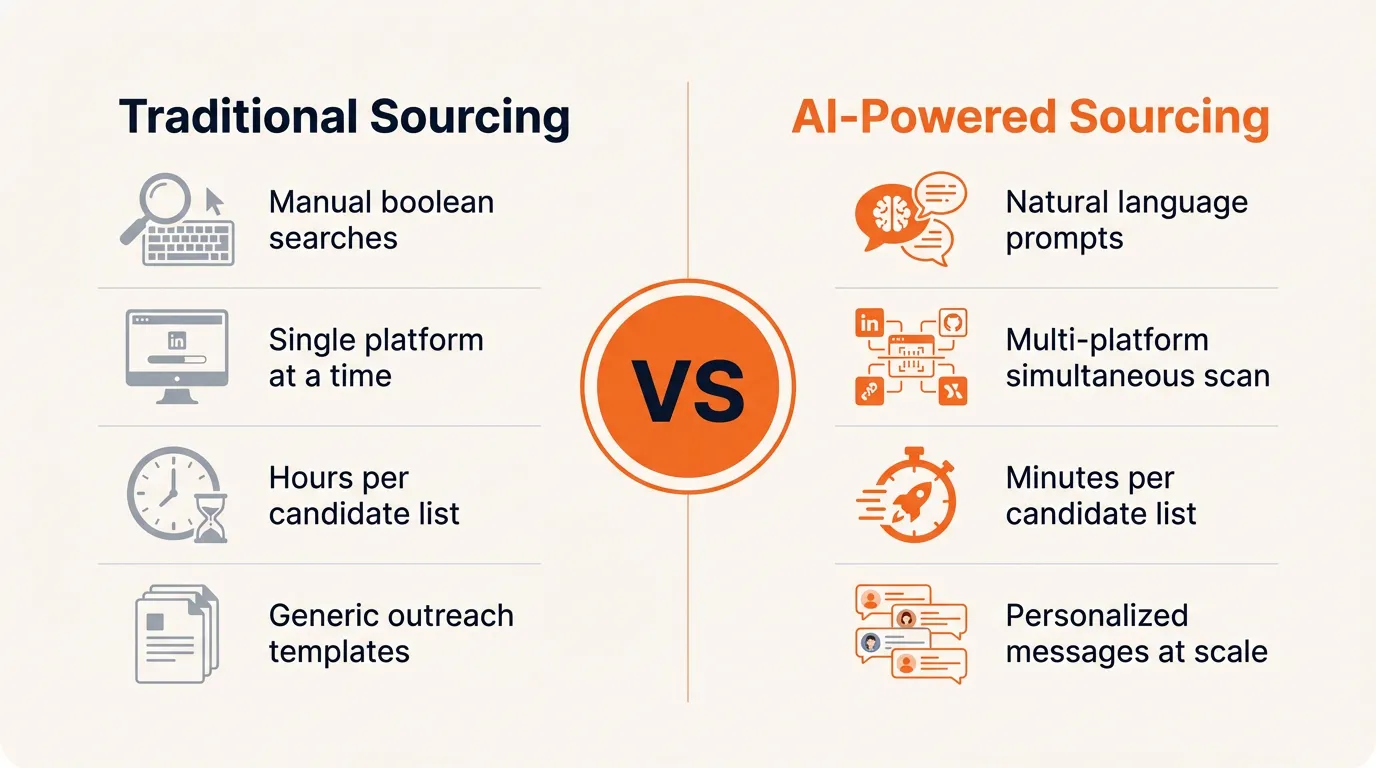
AI candidate sourcing uses artificial intelligence to find, screen, and engage potential candidates across multiple platforms and databases. Instead of a recruiter manually searching one platform at a time, AI scans professional networks, code repositories, portfolio sites, academic databases, and your own applicant tracking system simultaneously.
The core capabilities break down into four areas:
- Natural language search. Instead of building complex boolean strings, you describe your ideal candidate in plain language (“senior React developer with fintech experience in the Bay Area”) and the AI translates that into a multi-source search.
- Multi-platform scanning. AI searches across LinkedIn, GitHub, industry forums, portfolio platforms, and internal ATS records at the same time, surfacing candidates you would not find on a single platform.
- Candidate matching and ranking. Using natural language processing and machine learning, AI evaluates candidates based on skill patterns, career trajectories, and contextual signals rather than exact keyword matches. It ranks results by fit, not just recency.
- Automated outreach. AI drafts personalized outreach messages based on candidate profiles, manages follow-up sequences, and tracks engagement metrics.
The practical difference from traditional sourcing is speed and breadth. A recruiter might spend two hours building a candidate list on one platform. AI can scan hundreds of sources and return a ranked list in minutes. That does not mean the results are always better, but it means the initial discovery phase takes significantly less time.
How AI Sourcing Actually Works
Understanding the mechanics helps you evaluate whether AI sourcing fits your workflow and where it might fall short.
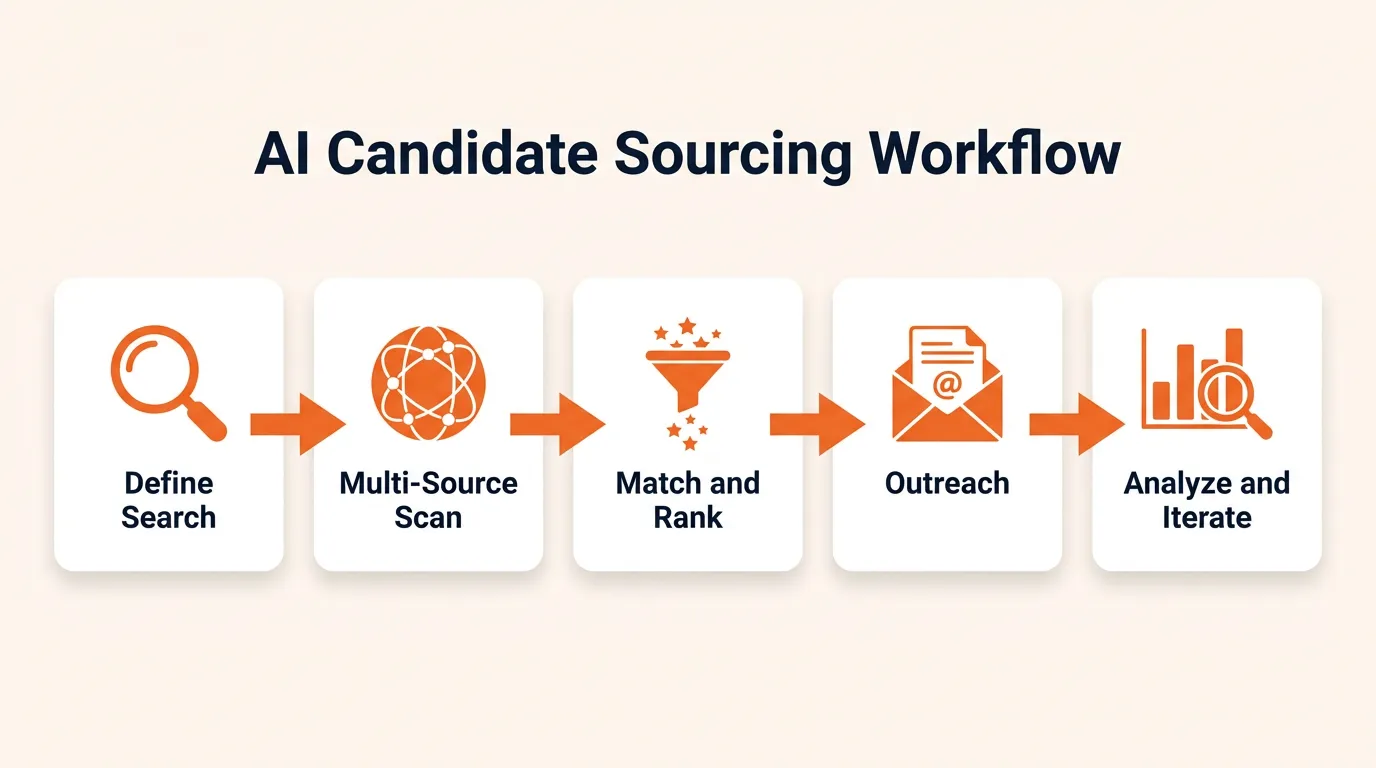
Defining the Search
The process starts with the recruiter providing search criteria. This can be a job description, a set of required skills and experience levels, or a natural language prompt. Modern AI sourcing tools accept conversational inputs, so instead of writing ("senior engineer" OR "staff engineer") AND ("React" OR "TypeScript") AND ("fintech" OR "payments"), you can type something like “I need a senior frontend engineer with React and TypeScript experience, ideally from a fintech or payments company.”
The AI parses this into structured search parameters, often identifying implicit requirements (like seniority level or industry context) that a boolean string would miss.
Multi-Source Scanning
Once the search is defined, AI queries multiple databases simultaneously. This typically includes professional networking platforms, code repositories like GitHub, portfolio sites for creative and design roles, academic publication databases, industry-specific forums, and the organization’s own ATS records.
This is where AI sourcing has a clear advantage over manual methods. A recruiter can realistically search one or two platforms deeply in a session. AI scans dozens of sources in parallel, which is particularly valuable for niche roles where the best candidates may not have active profiles on the most common platforms.
Candidate Matching and Ranking
AI does not just return everyone who matches a keyword. It uses NLP to understand semantic relationships between skills and roles, and machine learning to identify patterns that predict good fits. For example, AI might recognize that a candidate with “distributed systems” experience and “event-driven architecture” skills is a strong match for a role requiring “microservices expertise,” even if the candidate’s profile never uses that exact term.
The matching also surfaces passive candidates who are not actively job searching but have the right qualifications. AI can identify “silver medalist” candidates from your ATS, people who were strong contenders for previous roles but were not selected, and flag them for new opportunities.
Automated Outreach
After candidates are identified and ranked, AI can draft personalized outreach messages based on each candidate’s profile. The messages typically reference specific skills, recent projects, or career milestones to feel more relevant than a generic template.
However, recruiter feedback consistently shows that AI-drafted messages need significant editing. The technology is good at generating a starting point, especially when you need to send dozens of personalized messages in a day, but the output often sounds formulaic without a human touch. Think of it as a first draft that saves you 60% of the writing time, not a finished product.
Analytics and Iteration
AI sourcing platforms track search performance, response rates, and pipeline conversion metrics. This data helps recruiters refine their search criteria over time. If candidates from certain sources consistently convert at higher rates, the AI can weight those sources more heavily in future searches. Market salary benchmarks help align outreach with realistic compensation expectations.
What Recruiters Are Actually Saying About AI Sourcing
The vendor pitch for AI sourcing is compelling. The recruiter experience is more nuanced. Conversations across recruiting communities in 2025 and 2026 reveal a pattern worth understanding before you invest. (These insights are drawn from recruiter discussions on r/recruiting, r/recruitinghell, and other sourcing-focused communities.)
AI sourcing tools are improving but not yet transformative for most teams. Many recruiters report that dedicated AI sourcing tools are “interesting but not mature enough” to replace established platforms with standard filters. The tools work, but the gap between what is promised and what is delivered can be significant.
AI-drafted outreach is a time-saver, not a replacement for human messaging. Recruiters widely report that AI-generated InMail and email drafts are useful starting points. One common sentiment: “I find editing easier than writing from scratch when I have to do it over and over, so it is overall easier to have something to start with even if it is not great.” The consensus is that AI outreach saves time but needs heavy editing to avoid sounding generic.
AI note-taking is the quiet winner. Across multiple recruiter discussions, AI-powered note-taking for phone screens and interviews (using tools built into video platforms) is considered the most immediately useful AI capability in recruiting right now. It lets recruiters focus on the candidate instead of typing during calls.
AI chatbots for candidate engagement remain skeptically viewed. The feedback is direct: “Nobody is using an AI chatbot to engage any prospect of value. The communication is like fifth-grade level at best.” For high-value candidates, automated conversations are a turnoff.
The bottom line from practitioners: AI sourcing is useful for specific bottlenecks, especially high-volume candidate discovery and outreach drafting. It does not yet deliver on the “replace your entire sourcing workflow” promise that many vendors make.
Where AI Sourcing Delivers Real Value
Despite the mixed feedback, there are specific areas where AI sourcing produces measurable results.
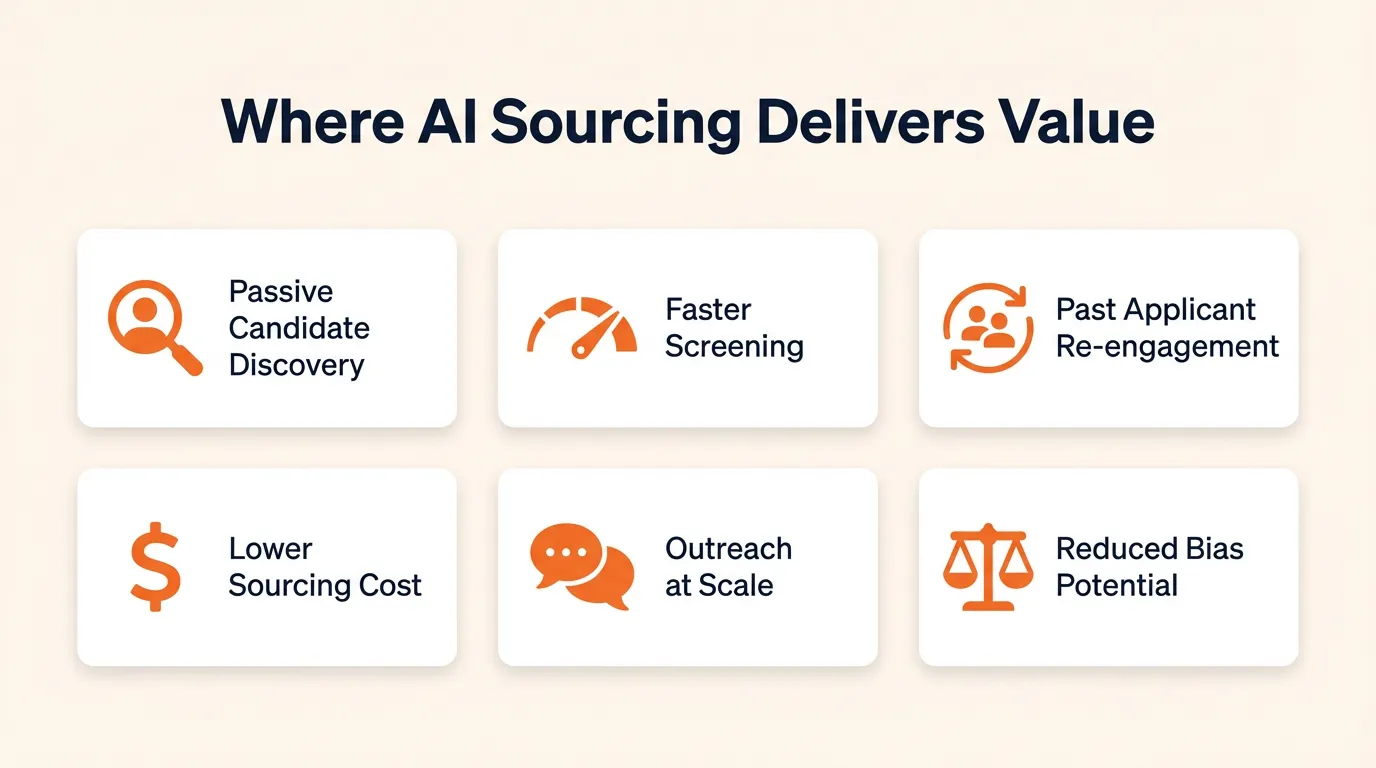
Passive Candidate Discovery
This is AI sourcing’s strongest use case. AI scans multiple professional platforms, portfolio sites, and public profiles simultaneously, identifying candidates who are not actively job searching but have the right qualifications. Manual sourcing typically covers one platform deeply. AI covers dozens of sources in parallel, which is how it finds candidates that traditional searches miss.
Early adopters report finding significantly more qualified passive candidates compared to manual methods, with some teams citing 30 to 40% larger qualified pipelines after switching to AI-driven multi-source searches. For hard-to-fill roles where the best candidates are not actively looking, this expanded reach makes a material difference.
High-Volume Screening at Speed
When you are processing hundreds of applications for multiple open roles, AI’s speed advantage becomes significant. AI can screen, match, and rank candidates in minutes rather than the hours or days it takes manually. Teams using AI sourcing report 30 to 50% faster time-to-hire, with the largest gains in high-volume hiring scenarios.
Past Applicant Re-engagement
Most organizations have a database of previous applicants who were qualified but not selected for earlier roles. These “silver medalists” are often forgotten. AI can automatically scan your ATS for past candidates who match new openings, flagging strong fits that would otherwise sit untouched in your database. This is one of the highest-ROI applications of AI sourcing because the candidates are already in your system and have previously expressed interest. If you need a framework for quantifying that return, see our guide on measuring AI recruiting ROI.
Reduced Sourcing Cost
Companies report 30 to 40% reductions in hiring costs after adopting AI sourcing tools. The savings come primarily from reduced recruiter hours spent on manual searching and screening, lower reliance on expensive platform licenses, and faster time-to-fill reducing the cost of unfilled positions.
Outreach Personalization at Scale
While AI-drafted messages need editing, the time savings are real when running multiple outreach campaigns simultaneously. AI generates a personalized first draft for each candidate based on their profile, recent activity, and role context. For teams reaching out to 50 or more candidates per week, this cuts hours of writing time even after accounting for manual editing.
Bias Reduction Potential
When configured properly, AI applies consistent evaluation criteria to every candidate, potentially widening the candidate pool beyond a recruiter’s existing network and referral patterns. By emphasizing skills and qualifications over education pedigree or employer brand recognition, AI sourcing can surface candidates from more diverse backgrounds. This is a potential benefit rather than a guarantee, though. AI trained on biased historical data can replicate and scale those biases, making continuous auditing essential.
Risks and Limitations to Watch
AI sourcing is not without trade-offs. Understanding these upfront helps you implement it more effectively.
Data Quality Issues
AI is only as good as the profiles it accesses. Outdated LinkedIn profiles, incomplete portfolio pages, and inaccurate contact information all degrade search quality. If the underlying data is stale, even the best matching algorithm will produce weak results.
Bias Amplification
If your historical hiring data contains patterns of bias, whether in who was sourced, screened, or hired, AI can replicate those patterns at scale. This is not a theoretical risk. It is the primary regulatory concern driving new AI hiring legislation. Continuous bias auditing is not optional; it is a core requirement for responsible AI sourcing.
Over-Reliance on Automation
AI cannot evaluate culture fit, communication nuance, motivation, or the subtle signals that experienced recruiters pick up in conversations. Teams that over-delegate to AI risk losing the human judgment that ultimately closes hires. The recruiters who get the most from AI sourcing use it for discovery and initial screening while keeping full control of evaluation and relationship-building.
Compliance and Regulatory Exposure
The US regulatory landscape for AI in hiring is expanding:
- NYC Local Law 144 requires employers using automated employment decision tools to conduct annual bias audits and notify candidates.
- Illinois AI Video Interview Act requires employer consent and transparency when AI analyzes video interviews.
- Colorado, California, and several other states have active or pending legislation addressing AI in employment decisions.
Teams need to track their jurisdiction’s requirements and ensure any AI sourcing tool supports transparency, auditability, and candidate notification where required.
Platform Rules and Rate Limits
LinkedIn and other professional platforms have terms of service that restrict automated scraping and mass outreach. Overly aggressive AI-driven activity can trigger account restrictions. Any AI sourcing tool you use should operate within platform guidelines, and you should understand what data access methods it uses.
Tool Maturity
As recruiter feedback shows, the gap between vendor marketing and operational reality can be significant. Many AI sourcing tools are still maturing, and switching costs are real. Pilot carefully before committing to annual contracts.
How to Actually Source Candidates Using AI
Most guides stop at “use AI tools.” This section covers the specific techniques recruiters are using right now, step by step, so you can start applying them today. It helps to understand the broader context of recruitment process automation before layering AI into specific stages. If you want a full walkthrough covering every step from job descriptions to scheduling, see our guide on how to use AI in recruiting.
Use ChatGPT or Claude to Build Better Search Queries
Before you touch any sourcing platform, use a general-purpose AI like ChatGPT or Claude to sharpen your search criteria. Paste your job description and ask it to:
- Extract the 10 most important skills and rank them by priority
- Suggest alternative job titles candidates might use on their profiles
- Generate boolean search strings for LinkedIn Recruiter or X-Ray searches
- Identify adjacent industries where the same skill sets exist
For example, prompt: “I’m hiring a senior data engineer with Spark and Airflow experience for a fintech company. Give me 5 boolean search strings for LinkedIn, 3 alternative job titles these candidates might use, and 2 adjacent industries I should search.”
This takes five minutes and dramatically improves the quality of every search you run afterward.
Automate Candidate Discovery with AI Sourcing Platforms
Once your search criteria are sharp, use a dedicated AI sourcing platform to run multi-source scans. Tools like Craze let you type your requirements in plain language and return ranked candidate profiles from across the web, without needing to build boolean strings or search each platform individually.
The key workflow:
- Define the role in natural language (not keywords). Be specific about skills, experience level, and industry.
- Run the AI search and let it scan professional networks, code repositories, portfolios, and your existing ATS simultaneously.
- Review and shortlist using the match indicators. Do not add every result to your pipeline. Filter first.
- Re-run with refined criteria based on what the first batch returns. AI sourcing improves with iteration.
Draft Personalized Outreach with AI
Generic templates get ignored. Use AI to draft personalized messages at scale:
- Feed candidate context into ChatGPT or Claude. Paste a candidate’s profile summary and your role details, then ask for a 3-sentence outreach message that references something specific about their background.
- Use platform-native outreach tools. Most AI sourcing platforms include built-in outreach with automated follow-up sequences. Set these up for high-volume roles, but always review the output before sending.
- A/B test subject lines and opening lines. Run two versions for every campaign and let response data tell you what works.
The recruiter consensus: AI-drafted messages save 50 to 60% of writing time, but always need a human pass to avoid sounding robotic.
Re-engage Past Applicants from Your ATS
This is the highest-ROI AI sourcing technique and the one most teams skip. Your ATS is full of qualified candidates who applied for previous roles but were not hired. AI can scan these records and match them against your current openings automatically.
Steps to set this up:
- Export or connect your ATS data to an AI sourcing platform that supports internal database scanning.
- Run matching against open roles to surface “silver medalist” candidates who were strong contenders before.
- Prioritize candidates with recent activity (updated profiles, new skills, job changes) as they may be open to new opportunities.
- Reach out with context. Reference their previous application: “You were a strong candidate for our backend role last year, and we have a new opening that might be an even better fit.”
Build Compliance In from Day One
Before scaling any AI sourcing workflow, confirm your tools and processes support:
- Bias audits with documented methodology (required in NYC, California, Illinois)
- Candidate transparency notices where required by your jurisdiction
- Audit trails showing how candidates were identified and ranked
- Data handling that meets your organization’s privacy requirements
Involve your legal team early. Retrofitting compliance after scaling is significantly more expensive than building it in from the start.
Keep Human Judgment at the Center
AI handles discovery, screening, and outreach drafting. Humans handle everything that requires judgment:
- Evaluating candidate quality beyond what a profile shows
- Building genuine relationships with high-value candidates
- Managing sensitive conversations about compensation, relocation, or career transitions
- Making final hiring recommendations
The teams getting the best results from AI sourcing are not replacing recruiters with AI. They are giving recruiters better tools so they can spend less time searching and more time on the work that actually closes hires.
Skip the Setup: Source, Shortlist, and Hire from One Place
All the techniques above work, but they still leave you juggling ChatGPT in one tab, LinkedIn in another, and your ATS in a third. Craze is an AI recruiting platform that puts sourcing, shortlisting, and pipeline management in a single workflow, so you go from “I need a candidate” to “they are in my pipeline” in minutes.
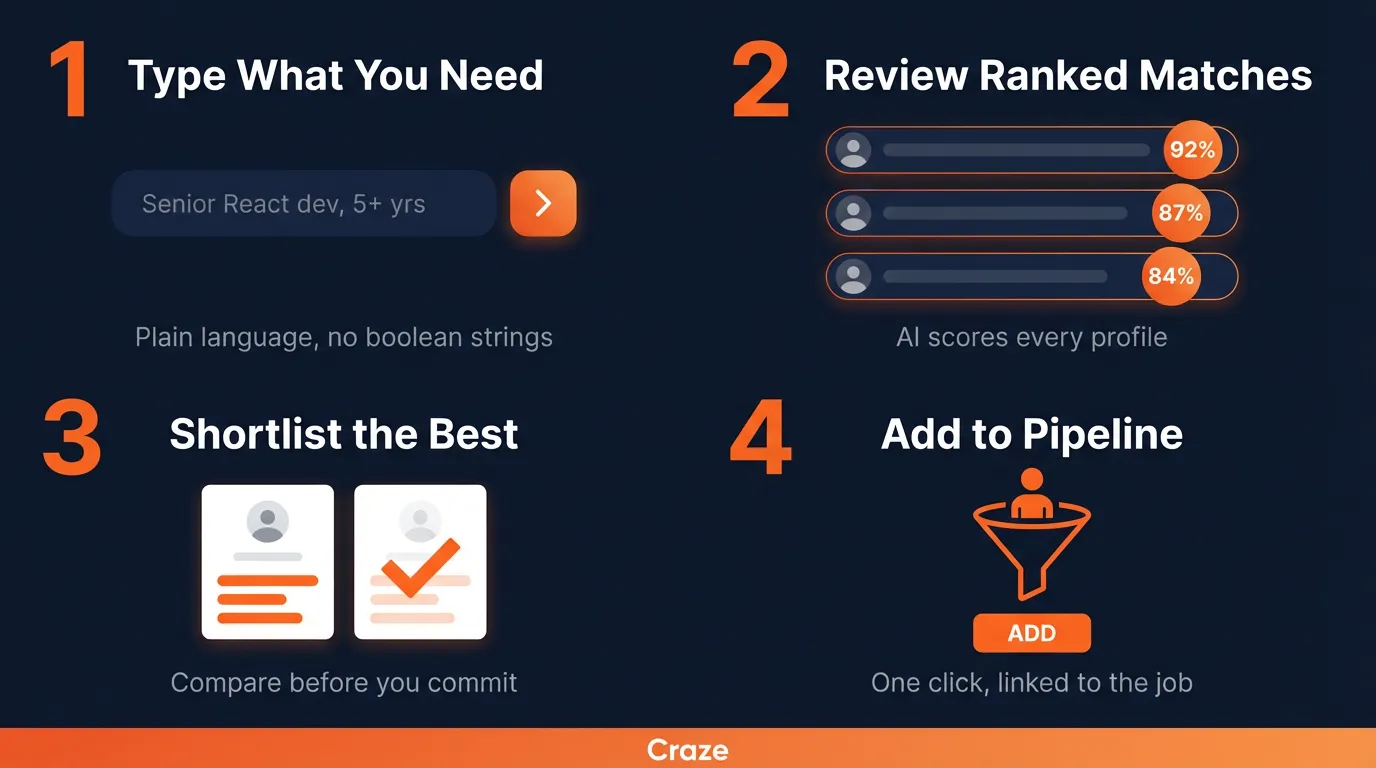
- Type what you need, skip the boolean. Select a job, describe your ideal candidate in the “Ask Craze AI” box, and get ranked results instantly.
- Every profile is scored. Craze AI returns candidate cards with match indicators so you can scan fit at a glance, not after reading 50 profiles.
- Shortlist before you commit. Bookmark the strongest profiles, compare them side by side, then add your top picks to the pipeline with one click.
- Better prompts, better results. “Senior backend engineer with Python and AWS, 4+ years in B2B SaaS” outperforms “backend engineer” every time. Iterate and refine.
Use the workflow above as a starting point, then refine your prompt with the exact role requirements, locations, and must-have signals you care about.
Start Sourcing Candidates for Free
Getting Started with AI Sourcing
AI candidate sourcing works best when you treat it as a targeted productivity tool rather than a wholesale replacement for your existing process.
The pattern that delivers results: identify your biggest sourcing bottleneck, test one AI capability against it for 90 days, measure rigorously, and scale what performs. Keep compliance and candidate experience at the center from day one.
The technology is improving rapidly, and what was underwhelming a year ago may be substantially better today. But the fundamentals have not changed. Great hiring still depends on recruiters who understand their roles, know their candidates, and build relationships that generic automation cannot replicate. AI just helps them do more of that work and less of the manual searching.
FAQs
Does AI candidate sourcing replace recruiters?
No. AI automates the discovery, screening, and initial outreach phases of sourcing. Recruiters still drive strategy, relationship-building, candidate evaluation, and final hiring decisions. The most effective teams use AI to handle high-volume tasks so recruiters can focus on high-value work like negotiation and culture assessment.
How much does AI sourcing reduce time-to-hire?
Teams using AI sourcing tools report 30 to 50% reductions in time-to-hire, though results vary by tool quality, implementation approach, and hiring context. The biggest gains come from automating high-volume candidate discovery and initial screening rather than trying to automate the entire funnel at once.
What compliance requirements apply to AI sourcing in the US?
NYC Local Law 144 requires bias audits for automated employment decision tools. Illinois requires consent for AI-analyzed video interviews. Several other states have pending legislation. Teams should consult legal counsel for jurisdiction-specific requirements and ensure their AI tools support transparency and auditability.
Can AI sourcing tools find passive candidates?
Yes, and this is one of AI sourcing's strongest use cases. AI scans professional networks, portfolios, code repositories, and other public profiles to identify candidates who are not actively job searching but match your requirements. This multi-platform reach is difficult to replicate manually.
How do I evaluate if an AI sourcing tool is worth the investment?
Run a focused 90-day pilot against a clear baseline. Measure time-to-fill, response rates, candidate quality, and cost-per-hire before and after. Compare results against your current sourcing costs and recruiter time allocation. Avoid committing to annual contracts before validating results with your own data.
More Articles
15+ AI Agent Examples That Are Actually Delivering Results

See real AI agent examples from companies like Uber, TELUS, and Intercom. Organized by function with actual business results, not just product names.
AI Agent Builders: How to Pick the Right Approach for Your Team
Compare no-code AI agent builders, developer frameworks, and custom approaches. Includes a decision matrix, cost ranges, and production readiness checklist.
How to Build an AI Agent (Even If You Can't Code)
Learn how to build an AI agent using no-code tools, frameworks like LangChain, or custom Python. Covers scoping, costs, and mistakes to avoid.


